
Ceramic foundry sand main applications are overwhelmingly within the foundry industry for metal casting, where it is used as a superior molding aggregate due to its unique spherical shape and excellent thermal properties.
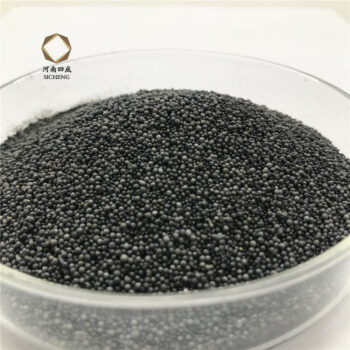
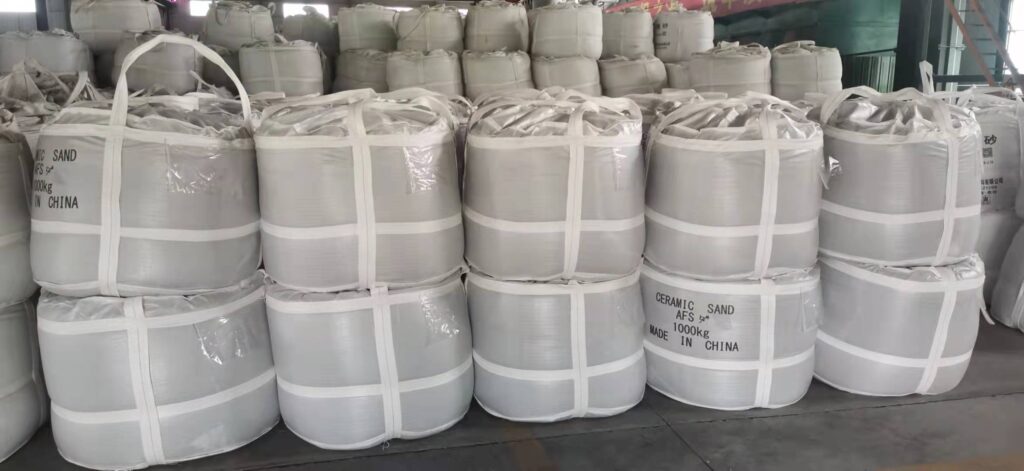
Primary Application: As a Molding and Coresand Aggregate in Advanced Casting Processes
Ceramic Fused Sand is not typically used for simple, low-duty sand casting. Its value is realized in more advanced, demanding, and high-quality casting processes.
1. Evaporative Pattern Casting (Lost Foam Casting)
Why it’s ideal: Its excellent flowability allows it to easily and densely fill the complex spaces around the foam pattern, ensuring a precise mold. Its high refractoriness prevents burn-in defects on the final casting surface.
2. V-Process (Vacuum Molding)
Why it’s ideal: The spherical grains ensure high and uniform permeability, which is crucial for maintaining the vacuum. It also provides a very smooth casting surface finish.
3. Cold Box and Hot Box Core Making
Why it’s ideal: Used for making complex and high-strength sand cores.
Low Resin Requirement: The spherical shape has less surface area compared to angular sand, leading to a significant reduction in resin binder usage (typically 20-30% less).
Excellent Core Quality: Produces cores with high strength, excellent collapsibility (reducing knockout effort), and superior thermal stability, preventing defects like veining.
4. 3D Sand Printing (Binder Jetting)
Why it’s the top choice: This is one of its fastest-growing applications.
Superior Flowability: The perfect spherical grains spread into thin, perfectly even layers, which is critical for achieving high dimensional accuracy and resolution in printed molds and cores.
High Strength & Smooth Surface: The resulting printed molds have excellent strength and produce castings with very smooth surface finishes.
5. Furan and Phenolic Resin Sand Systems (No-Bake and Cold-Set)
Why it’s ideal: It provides all the benefits of low resin consumption, good shakeout, and high refractoriness in these common chemically-bonded sand systems.
6. Precision Investment Casting
Why it’s ideal: Sometimes used as a filler or stucco material in the shell-building process for its high refractoriness and thermal shock resistance.
Key Advantages of the Ceramic Fused Sand
| Feature | Advantage in Foundry Application |
|---|---|
| Spherical Shape | Excellent Flowability: Fills complex molds and cores easily. High Permeability: Allows gases to escape easily. Low Resin Consumption. |
| Low Thermal Expansion | Prevents Veining & Rat Tails: Expands less than 1/10th of silica sand, drastically reducing these common casting defects. |
| High Refractoriness | Suitable for All Alloys: Withstands extremely high pouring temperatures (steel, iron, high-alloy metals) without fusing. Prevents Burn-On/Sand Fusion. |
| High Mechanical Strength | High Reclamation Rate (>95%): Grains do not fracture easily, allowing for repeated reuse. Reduces new sand purchases and waste disposal. |
| Alkaline & Chemically Neutral | Compatible with All Binder Systems: Does not react with acidic, alkaline, or phenolic resin systems. |
| Low Dust Generation | Improved Working Environment: Reduces respiratory hazards (no risk of silicosis) and is more environmentally friendly. |